
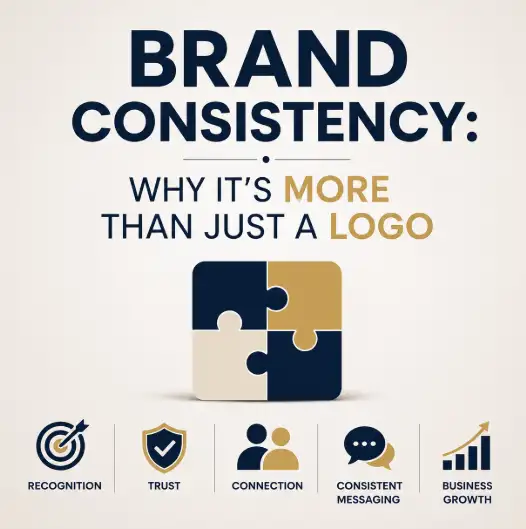
Introduction: Does Your Brand Make the Right Noise?
When you go to a brands instagram page and then head over to their website, but suddenly feel like your dealing with a different company? Different colors. Different tone of voice. Different energy. Confusing, right?
And that dislocation is exactly what occurs when brands deviate from brand consistency.
It is a common myth for most business owners that having a pretty logo constitutes a brand. But the reality is much more complex than that. Brand consistency is the backbone of every brand, big or small Before you see that logo, it is what brings Apple to the party. It is also why you see a McDonald’s ad long before reading even one word.
This guide will explain what brand consistency means, why it is important for your business, and how you can create it one step at a time even if you are starting from scratch.
What Is Brand Consistency? (And why you should care more than you think)
Brand consistency is when you present your brand in a uniform, consistent manner across all channels, platforms and touchpoints. This encompasses everything from your visual identity to brand messaging, tone of voice, customer experience all the way down to how team members communicate with one another.
In short, brand consistency means that your audience experiences the same feel and look and gets the same message across no matter if they find you on Google search, Instagram, your business card or in a store!
That means, using consistent branding across all channels can increase revenue up to 23%, according to Lucidpress. That is not a small number. In addition to this, brands that maintain consistent branding are 3.5 times more likely to achieve excellent brand recognition than their inconsistently presented competitors.
So, what goes into brand consistency? Let us break it down.
Core Elements of Consistent Branding
- Use of logo in proper positioning, Size and colors
- Color palette — same hex codes as in print and digital
- Typography matching typefaces for the headings and body text
- Brand voice and tone — speech and letter writing to your audience
- Brand messaging – your tagline, value proposition and key statements
- Visual — photography style, icons and other graphic elements
- Customer experience — as an outward-facing team, how your application/solution interacts with the customer
These components combine together to produce a brand identity that is recognizable, memorable and trustworthy.
Brand consistency is a business investment, not just a design choice.
This is where most entrepreneurs tend to go wrong. In many ways, they have reduced branding into a one-off creative exercise get a logo designed, choose some colors and go on with it. But consistency in the brand is a long term business strategy actually.
1. It Builds Trust and Credibility
Consumers will purchase from brands they trust Trust is built through familiarity. If your brand looks, sounds and feels the same everywhere, your audience will subconsciously put you in its good books as a reliable professional. Inconsistent branding, however, sends a message of disorganization that can make even the best products doubtful.
Observations: We have seen at Ad2Brand that clients who align their visual identity with their brand messaging perform better when it comes to engagement, with many reporting double the social media activity within 3 months of a brand audit.
2. It Improves Brand Recognition
Reach is one of the most valuable components of marketing. Coca-Cola’s red, Nike’s swoosh and Starbucks’ green mermaid – you get the idea. You don?t need to see their name for you to know who they are That kind of recognition is achieved from consistent branding at every single touchpoint for years.
This is crucial for local businesses and startups in particular. People in your area have to look at a billboard, Google ad and Facebook post, and believe they are seeing the same business.
3. It Supports Better Marketing ROI
Having a consistent brand identity naturally makes your marketing campaigns more effective. Your audience is trained for what they expect from you, so every new piece of content clarifies rather than confounds. Your design and content team also gets to save an ample amount of time since they are always working off the same set of brand guidelines rather than having to reinvent the wheel every single time.
4. It Strengthens Customer Loyalty
The most obvious fact: Customers with an emotional connection to your brand are for life. This is why your brand messaging is so critical to creating that emotional connection. If and only if, these elements are aligned– customers start to feel that they really know your brand. And repeat customers are the greatest brand ambassadors of all time.
5. It Differentiates You from Competitors
It is all about standing out in a saturated market. Having a consistent branding gives you a unique brand identity that your competitors cannot replicate easily. Your combination of visuals, tone, and messaging creates a signature experience that belongs to you alone.
Mistakes you can make in your brand consistency
These mistakes are even made by seasoned marketers. Watch out for the following:
- Signing off multiple versions of your logo without rules for each
- Adapting your brand voice based on who writes the content
- While recruiting freelancers or agencies, disregarding brand guidelines
- Color clashing with off-brand colors on social media graphics or presentations.
- Message Misalignment — Saying one thing on your site and a different message in ads
- Ignoring offline touchpoints like business cards, packaging and signage
- The never ending brand audit — not regularly reviewing your brand presence
If you have developed a brand strategy, avoiding these mistakes are not hard. Most businesses, however, do not bother to strategise at all – and this is when the inconsistency comes sneaking in.
Creating branding consistency — A step By step guide
These steps help you launch a new brand or refine an existing one.
Step 1 — Build your Brand Identity
Start with the fundamentals. Ask yourself:
- What does my brand stand for?
- Who is my ideal customer?
- What feelings do I want my brand to evoke?
- What differentiates me from others?
Those answers will form the basis for your answer to the question “what is a brand”
Step 2 — Create a Brand Style Guide
One source of truth style-guide (branding guidelines) It should include:
- Logo usage rules
- Defines the color palette with its exact codes (HEX, RGB, CMYK)
- Typography guidelines
- Image and photography style
- Writing and voice guidelines
- Brand messaging — tagline and key messages for your brand
When this is created, share this document with every team member, designer and agency partner.
Step 3 — Perform Audit Of Brand Presence
Conduct an audit of ALL the places your brand appears, Website, Email templates, Social Media profiles & posts to Printed Material and Packaging. Check for color, language or visual style inconsistencies. And then start working on the most visible ones first.
Step 4 — Align Your Team
Brand consistency is a team sport. So, do train your own inside team, including customer service people on your brand standards. Each individual communicating on your businesses behalf is a brand ambassador.
Step 5 — Utilize Templates and Automation
With design tools like Canva for Teams or Adobe Express, you can create locked templates that keep everything visually the same. Tools to limit formatting in emails marketing automation platforms such as HubSpot or Mailchimp also allow you to standardize email templates and visuals for a campaign.
Step 6 — Review And Evolve Regularly
Brands grow. Markets change. Check your brand consistency at least every 6 months. Gradual change with intent rather than cold turkey is needed when updating your branding.
Tools to Help You Maintain Brand Consistency
Here are some practical tools to keep your branding on track:
| Tool | Purpose |
|---|---|
| Canva for Teams | Consistent social media and design templates |
| Brandfolder | Brand asset management and storage |
| Frontify | Digital brand guidelines platform |
| HubSpot | Consistent email and marketing campaigns |
| Google Fonts | Typography standardization |
| Coolors.co | Color palette creation and sharing |
| Notion / Confluence | Hosting and sharing brand guidelines internally |
Conclusion: Your Brand Is a Promise — Deliver On That Promise Every Day
Brand consistency is not a design nicety. It is a business necessity. Every interaction your audience has on your brand be it scrolling your Instagram, reading your email or entering your store is an opportunity to create or destroy trust.
Showing up consistently with the same brand identity, brand messaging and visual style makes others not forget you. You become trustworthy. You are the first to come because your name comes up whenever a refers or someone NEEDS what you offer.
So, do not go on sending mixed signals from your brand. Instead, take the time to define it clearly, write it down thoroughly, and execute it consistently every single day.
Are you ready to build a brand that will be recognized and recalled by the people? At Ad2Brand, we build effective continuous branding and identity powerhouses for businesses. Contact us now to assist you take the brand advancement in your organisation to following level.
Frequently Asked Questions (FAQs)
Q1: Defining brand consistency and why you need it?
Brand consistency relates to having the same visuals, tone, and messaging across various channels and touchpoints. It matters because it builds customer trust, creates brand awareness, and can even boost revenue by as much as 23%, according to Lucidpress.
Q2: How does Brand Consistency helps to build Customer trust?
When customers notice the same colors, fonts, tone, and messaging time & again they start to connect your brand with reliability and professionalism. Consistency in branding helps to remove any doubt, and ensure customers always feel as if they are engaging with a trustworthy business.
Q3: Can you explain what is brand identity and what it is brand consistency?
Brand Identity Image Source The main takeaway of this brand is that the general look and feel, especially with respect to visual ground elements (logo, colors, typography everything related to visuals) and written word (brand voice specifically). Brand consistency is the implementation of those elements consistently across every channel and communication. Identity is what you make; consistency is how you keep it.
Q 4: How frequently do I need to review my brand consistency?
You should ideally do a brand audit at a minimum of every 6 months. Nevertheless, whenever you release a new product line, enter a new market or refresh your visual identity there is an immediate need to reassess all brand touchpoints.
Q5: What are some tools to keep small businesses consistent with branding?
Software such as Canva for Teams, Brandfolder and Frontify are ideal for keeping your branding consistent. Furthermore, the cheapest action possible any small business can undertake is developing a brand style guide and distributing it to all team members and partners.