
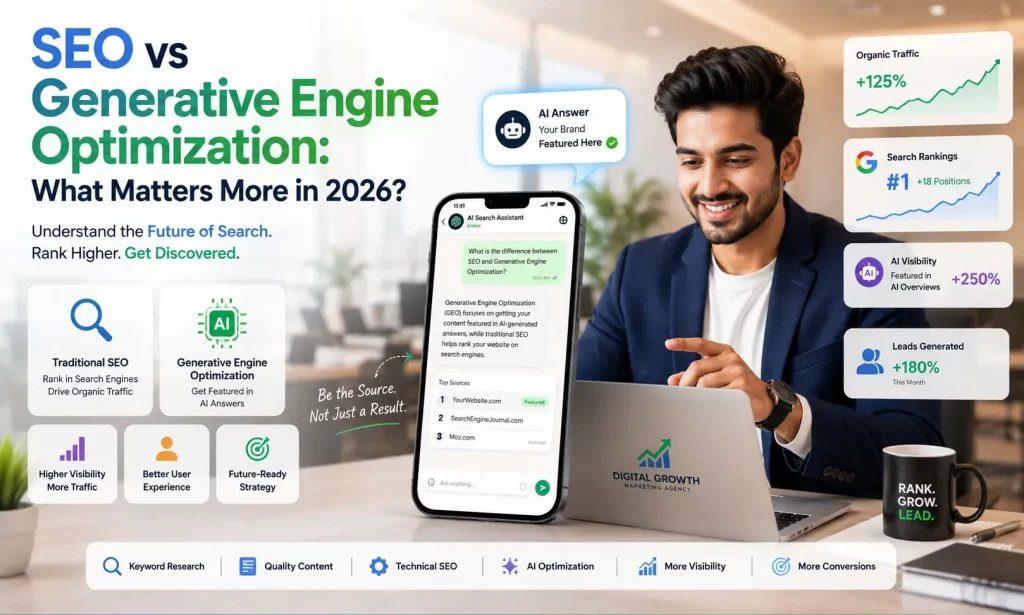
The digital marketing world is changing faster than ever. Traditional search engine optimization has dominated online visibility strategies for years, but AI-powered search experiences are rewriting the rules. Businesses that once focused only on ranking on Google’s first page are now trying to appear inside AI-generated answers, conversational search results, and smart assistants.
That is why the debate around SEO vs Generative Engine Optimization has become one of the hottest topics in digital marketing for 2026.
Search engines are no longer just displaying links. Platforms powered by artificial intelligence now provide direct answers, summaries, recommendations, and personalized responses. This major shift is creating a new era where businesses must optimize not only for search engines but also for AI-driven answer engines.
So, what matters more in 2026? Traditional SEO or Generative Engine Optimization? The reality is more nuanced than choosing one over the other.
In this guide, we will explore the complete comparison between SEO vs Generative Engine Optimization, how AI search is changing user behavior, and what businesses should do to stay visible in the future of digital marketing.
What Is SEO?
Search Engine Optimization (SEO) is the process of improving a website’s visibility on search engines like Google, Bing, and Yahoo. The main goal is to rank higher for relevant keywords and attract organic traffic.
Traditional SEO focuses on:
- Keyword optimization
- High-quality content
- Technical SEO
- Link building
- Mobile optimization
- Page speed
- User experience
For example, if someone searches “best digital marketing agency in Indore,” Google shows a list of web pages ranked according to relevance and authority.
SEO has been incredibly effective for businesses because higher rankings usually mean:
- More traffic
- Better brand visibility
- More leads
- Increased sales
However, search behavior is evolving rapidly.
What Is Generative Engine Optimization?
Generative Engine Optimization (GEO) is the process of optimizing content so AI-powered search engines and answer engines can understand, trust, and recommend it in AI-generated responses.
Unlike traditional search engines that display links, AI systems often generate direct answers.
This includes platforms like:
- Google AI Overviews
- ChatGPT
- Gemini
- Perplexity AI
- Microsoft Copilot
When users ask complex questions, AI tools summarize information instead of showing only website links. That means businesses now need visibility inside AI-generated answers.
This is where SEO vs Generative Engine Optimization becomes extremely important.
Generative engine optimization focuses on:
- Context-rich content
- Topical authority
- Structured information
- Conversational content
- Entity-based optimization
- Trustworthiness and expertise
- AI readability
In simple words, SEO helps websites rank in search engines, while GEO helps brands appear in AI-generated answers.
SEO vs Generative Engine Optimization: Core Differences
1. Search Results vs AI Answers
Traditional SEO focuses on ranking web pages.
Generative engine optimization focuses on becoming part of AI-generated responses.
Example:
Traditional Search:
Google shows 10 blue links.
AI Search:
AI provides one summarized answer using multiple trusted sources.
2. Keywords vs Context
SEO heavily depends on keyword targeting.
Generative engine optimization focuses more on contextual understanding and semantic relevance.
AI systems understand intent better than traditional algorithms.
3. Clicks vs Visibility
Traditional SEO prioritizes website traffic.
AI answer engine optimization prioritizes brand mentions and authority, even if users do not click immediately.
This changes how businesses measure success.
4. Content Structure
SEO content is often optimized around exact keywords.
AI search optimization requires:
- Natural language
- Clear formatting
- FAQ sections
- Expert insights
- Data-backed information
5. User Intent
AI-driven platforms prioritize highly specific user intent.
Instead of short keywords like:
“SEO agency”
Users now ask:
“Which digital marketing agency is best for local businesses in India?”
This shift is transforming the entire future of SEO.
Why AI Search Is Changing Digital Marketing
Artificial intelligence is fundamentally changing how people discover information online.
Modern users want:
- Faster answers
- Personalized recommendations
- Conversational experiences
- Less effort searching through links
AI tools provide exactly that.
Recent trends show that younger users increasingly prefer conversational AI platforms over traditional search methods for research and recommendations.
This creates a massive challenge for businesses relying only on traditional SEO strategies.
If your brand is not optimized for AI answer engines, you risk losing visibility in the coming years.
That is why understanding SEO vs Generative Engine Optimization is critical for long-term growth.
Benefits of Traditional SEO
Even though AI search is growing rapidly, SEO is still extremely important in 2026.
Higher Organic Traffic
Ranking on Google still drives massive traffic for businesses.
Better Long-Term ROI
SEO continues delivering traffic over time without constant advertising costs.
Strong Local Visibility
Local SEO remains essential for businesses targeting nearby customers.
Example:
- Restaurants
- Clinics
- Interior designers
- Real estate agencies
Brand Trust
Users still trust websites ranking on Google’s first page.
Supports AI Visibility
Interestingly, strong SEO also improves AI search visibility because AI systems often pull information from authoritative websites.
This means traditional SEO is still the foundation of online visibility.
Benefits of Generative Engine Optimization
Now let us explore why businesses are investing heavily in generative engine optimization.
Better AI Visibility
Brands optimized for AI answer engines appear inside AI-generated recommendations and summaries.
Increased Brand Authority
AI systems prioritize trusted, authoritative sources.
This pushes businesses to improve content quality significantly.
More Conversational Reach
Users now ask longer, natural-language questions.
AI search optimization helps businesses capture these conversational queries.
Future-Proof Marketing Strategy
Businesses adopting GEO early gain a major competitive advantage.
The future of SEO will strongly integrate AI visibility.
Better User Experience
Generative engine optimization encourages:
- Clear writing
- Helpful content
- Human-first communication
This improves engagement and trust.
AI Search Optimization Strategies for 2026
To succeed in the battle of SEO vs Generative Engine Optimization, businesses should combine both strategies.
Here are the most effective techniques for 2026.
Create Deep Topical Content
AI systems prefer comprehensive, expert-level content.
Instead of writing shallow blogs, create:
- Detailed guides
- Case studies
- Tutorials
- Research-backed articles
Focus on EEAT
Google and AI systems value:
- Experience
- Expertise
- Authoritativeness
- Trustworthiness
Add:
- Real examples
- Author bios
- Statistics
- Industry insights
Optimize for Conversational Queries
People now search using natural language.
Example:
Instead of:
“best SEO tools”
Users ask:
“What are the best SEO tools for small businesses in 2026?”
Structure content around conversational intent.
Use FAQ Sections
FAQ sections help AI understand content better.
This improves chances of appearing in AI-generated responses.
Improve Content Readability
AI systems prefer well-structured content.
Use:
- Short paragraphs
- Bullet points
- Simple language
- Clear headings
Build Strong Brand Mentions
AI answer engine optimization depends heavily on online authority.
Increase mentions through:
- PR campaigns
- Guest posting
- Social proof
- Reviews
- Industry collaborations
Use Structured Data
Schema markup helps AI systems interpret website content more accurately.
Important schema types include:
- FAQ schema
- Article schema
- Local business schema
- Product schema
Real-World Examples of AI Search Behavior
Understanding user behavior helps explain the importance of SEO vs Generative Engine Optimization.
Example 1: Product Recommendations
Traditional Search:
Users compare multiple websites manually.
AI Search:
Users ask:
“Which laptop is best for graphic designers under $1000?”
AI gives direct recommendations instantly.
Example 2: Healthcare Searches
Traditional Search:
Users open many medical websites.
AI Search:
AI summarizes symptoms and possible solutions immediately.
Example 3: Local Business Discovery
Traditional SEO:
Businesses compete for map rankings.
AI Search:
Users ask:
“Which interior design company in Indore has the best reviews and affordable pricing?”
AI tools summarize the top options.
This changes how businesses attract leads online.
Common Mistakes Businesses Must Avoid
Ignoring AI Search Trends
Many businesses still believe traditional SEO alone is enough.
That mindset is risky in 2026.
Creating Thin Content
AI systems dislike low-value, keyword-stuffed articles.
Focus on usefulness instead.
Over-Optimizing Keywords
Keyword stuffing damages readability and trust.
Write naturally.
Neglecting Brand Authority
AI systems prioritize trusted brands.
Without credibility, visibility becomes difficult.
Not Updating Old Content
Freshness matters for both SEO and generative engine optimization.
Update blogs regularly.
Future of SEO in the AI Era
The future of SEO is not about replacing traditional optimization.
It is about evolution.
SEO and generative engine optimization will work together.
Businesses that combine:
- Technical SEO
- Content marketing
- AI search optimization
- Brand authority
- User experience
will dominate online visibility in the coming years.
In 2026 and beyond, winning brands will not just rank on search engines — they will become trusted sources for AI-generated answers.
That is the real future of digital marketing.
Conclusion
The debate around SEO vs Generative Engine Optimization is not about choosing one over the other. The smartest businesses in 2026 will use both together.
Traditional SEO still drives visibility, traffic, and rankings. At the same time, generative engine optimization is becoming essential for AI-driven discovery and conversational search.
As AI search optimization continues evolving, brands that focus on trust, authority, user experience, and high-quality content will stay ahead of the competition.
The future belongs to businesses that adapt early.
If your strategy only focuses on old-school SEO, you may lose visibility in the AI-powered future.
But if you combine SEO with AI answer engine optimization, you can dominate both traditional search engines and next-generation AI platforms.