
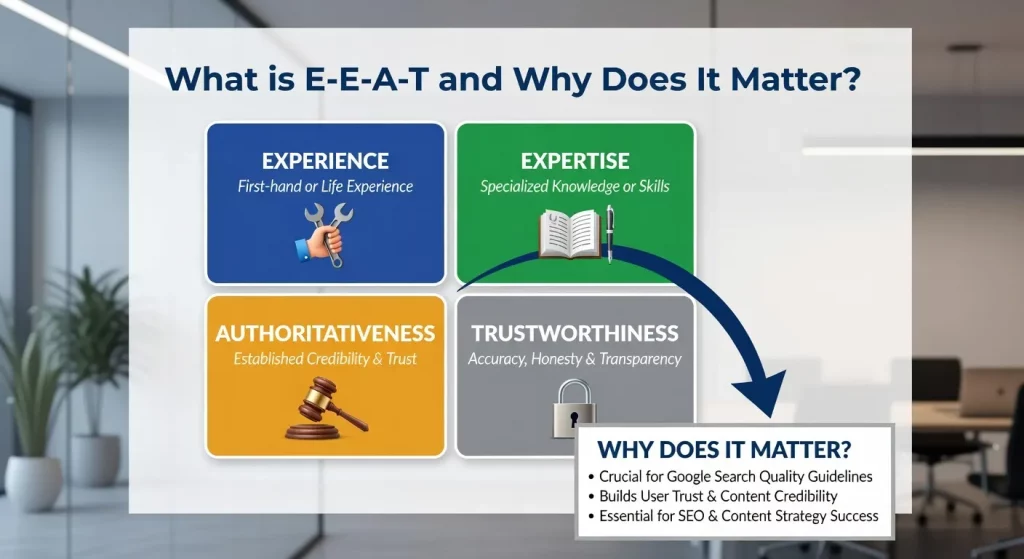
What is E-E-A-T?
If you’ve been keeping up with SEO trends, you’ve likely come across the term E-E-A-T. But what is E-E-A-T exactly, and how does it affect your website’s visibility on Google? At 20clicks, we help businesses and content creators understand what is E-E-A-T so they can build content strategies that earn long-term trust and rankings. This guide breaks down everything from the core definition of what is E-E-A-T to practical tips, a full checklist, and the SEO benefits of applying it correctly.
E-E-A-T stands for Experience, Expertise, Authoritativeness, and Trustworthiness. It is a framework Google uses through its Search Quality Rater Guidelines to evaluate the quality of web content. The concept originated as E-A-T (without the first “E”), but in December 2022, Google added “Experience” to emphasize the importance of first-hand, real-world knowledge.
E Experience
Direct, first-hand involvement with the subject. A reviewer who actually used the product scores higher than one speculating.
E Expertise
Formal or informal depth of knowledge. A doctor explaining health, or a mechanic covering car repair.
A Authoritativeness
Recognition from others backlinks, citations, mentions, and industry reputation signals.
T Trustworthiness
The most critical pillar. Accurate info, transparent practices, secure website, and honest content.
Why is E-E-A-T Important for Google?
Google processes billions of searches daily, and its core mission is to deliver the most relevant and reliable results. Google trains its Search Quality Raters human evaluators who assess page quality using the E-E-A-T framework. While E-E-A-T is not a direct algorithmic ranking factor, it heavily influences how Google’s systems reward or suppress content over time.
Google’s helpful content system, the Medic Update, and core algorithm updates have all shown a consistent pattern: sites with strong E-E-A-T signals rank better, recover faster after updates, and maintain stable traffic. For YMYL (Your Money or Your Life) categories health, finance, law, and news E-E-A-T signals are scrutinised even more intensely because misinformation in these areas can cause real harm.
Is E-E-A-T a Ranking Factor?
This is one of the most debated questions in SEO. Technically, E-E-A-T is not a direct ranking factor in the same way that page speed or backlinks are. Google does not assign a single “E-E-A-T score” to pages. However, E-E-A-T is deeply connected to signals that are direct ranking factors link quality, user engagement, content accuracy, and site reputation.
Think of E-E-A-T as a quality benchmark. When your content demonstrates strong experience, proven expertise, recognized authoritativeness, and genuine trustworthiness, it naturally accumulates the technical and off-page signals that Google’s algorithms respond to positively. At 20clicks, we advise treating E-E-A-T as a strategic quality standard because the improvements you make to demonstrate it will result in measurable ranking gains.
- Backlink quality
- Author credibility
- Site security (HTTPS)
- Reviews & reputation Content accuracy
E-E-A-T in Content Writing
Applying what is E-E-A-T in content writing means producing articles, blogs, and guides that signal credibility at every level. This goes far beyond simply knowing your topic.
Experience in content
Include first-hand accounts, personal case studies, original data, photos, or testimonials. If you are reviewing a product, show that you have actually used it. Google’s systems and quality raters are increasingly rewarding content that reflects genuine lived experience rather than generic information.
Expertise in content
Demonstrate deep knowledge by covering topics thoroughly, using accurate terminology, citing credible sources, and explaining nuanced points that a generalist writer would miss. Include author bios that highlight qualifications, years of experience, and relevant credentials. Every article on 20clicks’s blog is attributed to a named expert whose background in digital marketing is clearly stated.
Authoritativeness in content
Authority is built externally over time. Earn mentions and links from reputable publications. Guest post on authoritative sites. Build a social presence where subject-matter experts engage with your content. Create resources that others naturally reference original research, comprehensive guides, and data-backed reports are particularly effective
Trustworthiness in content
Maintain factual accuracy, link to credible external sources, update outdated content, display clear contact information, publish a transparent privacy policy, and use HTTPS. Avoid clickbait headlines that overpromise, and never publish misleading statistics or unverified claims.
E-E-A-T Checklist for Your Website
Use this practical checklist to audit and strengthen your site’s E-E-A-T profile:
✓ Add detailed author bios with credentials, experience, and links to professional profiles
✓ Include first-hand experience elements original photos, case studies, real data, or user-generated content
✓ Cite authoritative external sources and link to peer-reviewed studies and reputable organisations
✓ Regularly audit and update existing content to ensure accuracy and freshness, especially for YMYL topics
✓ Display an ‘About Us’ page with team profiles, company history, and a clear mission statement
✓ Make contact information easy to find address, email, phone, or a contact form
✓ Secure your site with HTTPS and maintain a clean, malware-free environment
✓ Collect and display reviews on third-party platforms (Google Reviews, Trustpilot, Clutch)
✓ Build quality backlinks through PR, digital outreach, guest posts, and original research
✓ Publish a transparent editorial policy or content disclosure where relevant
✓ Avoid AI-generated content without human review, editing, and expert sign-off
✓ Include content review dates so readers and Google can verify when information was last checked
E-E-A-T Guidelines from Google
Google’s Search Quality Rater Guidelines are publicly available and span hundreds of pages. The key sections relevant to E-E-A-T cover how raters assess the main content of a page, the reputation of the website and content creator, and whether the page meets the needs of searchers. While quality raters don’t directly influence rankings, their feedback refines Google’s automated systems.
The guidelines make clear that for YMYL topics, the bar for E-E-A-T is significantly higher. A page giving financial advice from an uncredentialed author on a little-known website would score far lower than the same advice from a qualified financial planner on a regulated institution’s website. 20clicks recommends downloading the latest version of Google’s Quality Rater Guidelines and using it as a reference whenever planning content in a high-stakes niche.
One of the most actionable takeaways from the guidelines is the concept of the beneficial purpose of a page. Every piece of content you publish should have a clear, positive purpose for the user informing, educating, solving a problem, or entertaining. Content created primarily for search engines rather than people will consistently underperform in a world where E-E-A-T matters.
SEO Benefits of E-E-A-T
When you invest in E-E-A-T consistently, the SEO dividends compound over time. Here are the
measurable benefits:
Ranking stability
High-E-E-A-T sites weather core algorithm updates better and recover faster from any volatility.
Higher CTR
Credible author names and trustworthy brand signals improve click-through rates from SERPs.
Featured snippets
Authoritative, well-structured content is more likely to be selected for position zero.
Brand authority
Consistently trustworthy content builds long-term brand equity and referral traffic.
Beyond rankings, E-E-A-T improvements boost conversion rates. Users who perceive a site as trustworthy and authoritative are more likely to sign up, purchase, or enquire. At 20clicks, clients who implement a full E-E-A-T content strategy see improvements not just in organic rankings but in bounce rate, session duration, and lead quality because the same qualities that impress Google also build trust with real human readers.
Frequently Asked Questions
1. What is E-E-A-T and how is it different from the old E-A-T?
E-E-A-T stands for Experience, Expertise, Authoritativeness, and Trustworthiness. Google added the first ‘E’ for Experience in December 2022, recognising that direct, hands-on experience is a distinct quality signal from formal expertise alone. The original E-A-T framework did not differentiate between someone who had studied a topic and someone who had lived it the updated framework does.
2. Is E-E-A-T a direct Google ranking factor?
Not directly. E-E-A-T is a framework used by Google’s Search Quality Raters to assess content quality. However, the signals that demonstrate strong E-E-A-T authoritative backlinks, credible authorship, factual accuracy, site security, and positive brand reputation are closely tied to the technical and off-page factors that Google’s algorithms do measure. Improving your E-E-A-T indirectly improves your rankings.
3. Does E-E-A-T matter for all types of websites?
E-E-A-T matters for all websites, but the stakes are highest for YMYL (Your Money or Your Life) niches such as health, finance, legal advice, and news. Any website that wants to grow organic traffic sustainably will benefit from building strong E-E-A-T signals.
4. How can a small business or new website build E-E-A-T?
Start with the fundamentals: secure your site with HTTPS, create a detailed About page, add author bios with genuine credentials, cite reputable sources, and encourage satisfied customers to leave reviews. Build relationships with other authoritative sites in your niche for guest posting opportunities. At 20clicks, we recommend a 90-day E-E-A-T audit plan for new sites covering both on-page credibility signals and off-page reputation building.
5. Can AI-generated content meet E-E-A-T standards?
AI-generated content alone typically struggles to demonstrate genuine Experience and authentic Expertise. However, AI can support E-E-A-T-compliant content when supervised, edited, fact-checked, and enriched by subject-matter experts. The key is human oversight and the addition of original perspectives, real-world data, and verified accuracy before publishing. Google’s stance is not anti-AI but pro-quality: content must be helpful and trustworthy regardless of how it was produced.
Conclusion
Understanding what is E-E-A-T is no longer optional for anyone serious about SEO and content
marketing. It represents Google’s clearest signal yet about the kind of web it wants to reward: one built on genuine experience, real expertise, earned authority, and transparent trust. Whether you run a personal blog, a B2B SaaS platform, or a full e-commerce store, the principles of what is E-E-A-T apply and the sites that take them seriously will consistently outperform those that don’t. At 20clicks, we are committed to helping you implement E-E-A-T from strategy through to execution, so your content doesn’t just rank it resonates, converts, and lasts.